The AI Shift: How It’s Reshaping Custom Software Development and Client Expectations
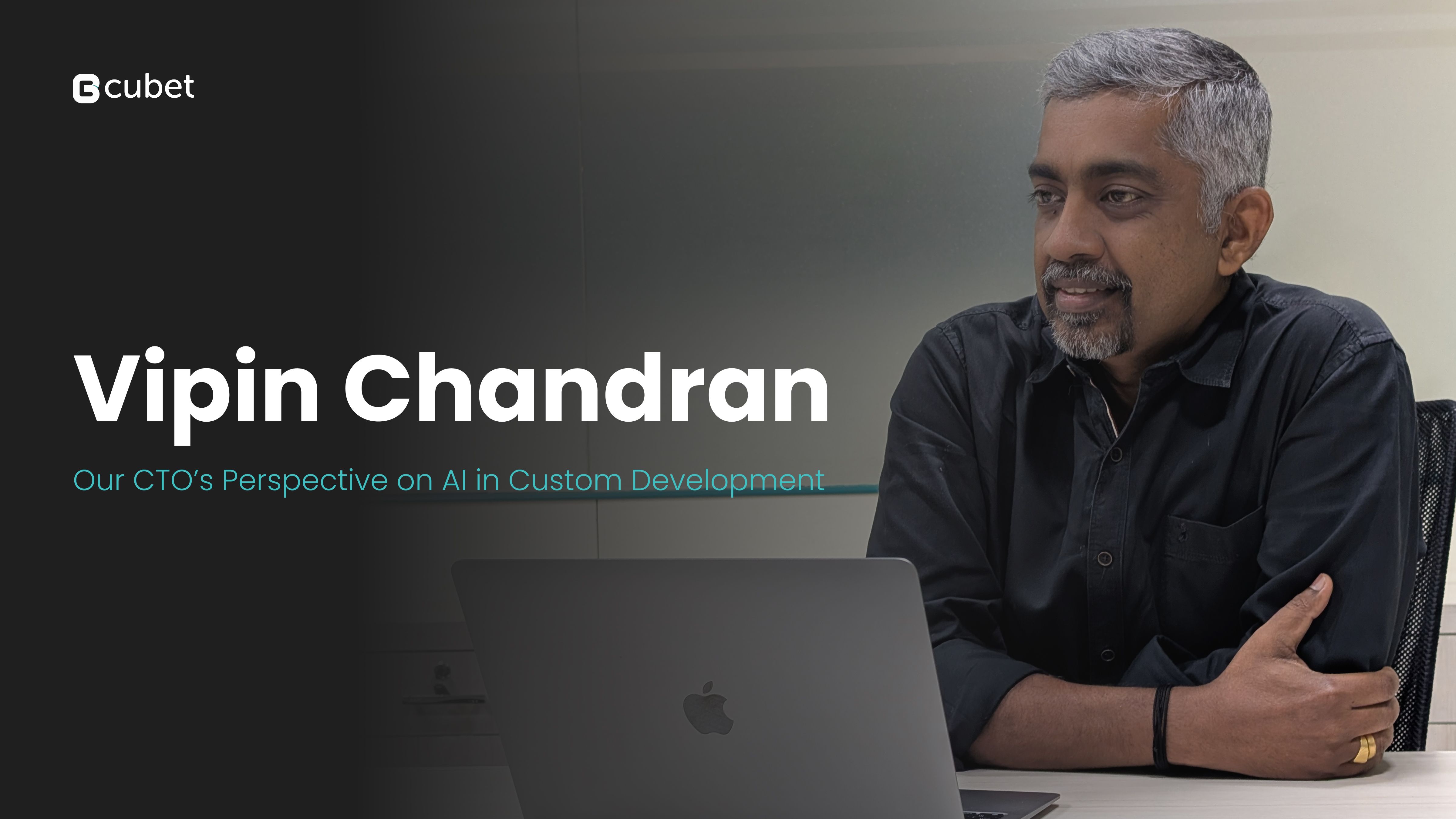
We had the opportunity to sit down with Mr. Vipin Chandran, CTO of Cubet and an expert in Artificial Intelligence and its applications. In this conversation, he shares his thoughts for the future of AI in custom software development, unpacks the key challenges shaping the industry, and reflects on what excites him most about the next wave of intelligent technologies.
How do you see AI transforming the landscape of custom application development over the next few years?
Artificial Intelligence will fundamentally reshape the IT landscape. This will be mainly by automating processes. E.g., AIOps for proactive system management, generative AI in coding, etc. Enhancing cybersecurity through real-time threat detection, and the emergence of products like AI-driven SaaS platforms and edge computing solutions are a few of the other developments that will come in. Prioritizing strategic roles over routine tasks will require developers and managers to upskill or be left out. Modernizing legacy infrastructure to support AI workloads and fostering human-AI collaboration to maintain trust and agility will be important corrections that will be required in this era, where adaptability defines market leadership.
In what areas of custom software solutions do you think AI can deliver the most immediate value for businesses?
AI can deliver immediate value in custom software solutions by accelerating development efficiency through automated code generation. But it's important to note that AI should only be used as a co-pilot. Another area where AI can speed up stuff in custom software solutions is intelligent Testing. Testers can utilise AI to generate test cases and also to automate the testing effectively to speed up the testing process. Automating repetitive tasks with NLP-driven bots (e.g., customer support chatbots, document processors), detecting fraud or threats in real time, and improving data utility by extracting insights from unstructured sources (e.g., sentiment analysis, document summarization) are some of the other areas where AI can play a significant role.

How is AI changing client expectations when they approach IT service companies like ours for custom solutions?
With the arrival of AI into the active application development process, clients now demand faster delivery, higher intelligence, and better value creation. Clients now expect AI-powered solutions that learn and adapt over time (e.g., intelligent chatbots or self-optimizing systems). They also prioritize speed-to-value, leveraging AI-driven development tools (e.g., low-code platforms, code generators) to reduce timelines and costs while maintaining agility.
What are some common misconceptions businesses have about integrating AI into their applications?
First misconception is regarding the data that is required to train model. Many believe that a large quantity of data will make the AI respond better. But rather than quantity, it is the quality of data, even if supplied in small portions, that governs the accuracy of the solution. Some treat AI as a universal fix, applying it to problems better solved by simpler tools. Additionally, many ignore ethical risks (bias, privacy violations) until after deployment, and also underestimate talent shortages in specialized roles (e.g., MLOps).
With rapid advancements in AI, how should IT service providers balance between taking advantage of AI and maintaining traditional development practices?
To balance AI adoption with traditional development, IT service providers should adopt a hybrid approach in which AI works as a Co-pilot, while proven practices still get followed. Integrate AI tools (e.g., code assistants, automated testing) to boost efficiency while retaining human oversight for complex logic and decisions. Upskill teams to become AI fluent. Deploy AI incrementally in low-risk areas first, applying traditional project management processes (e.g., Agile/DevOps) to maintain transparency and compliance. Align AI’s speed and scalability with client needs for innovation, while preserving customization and long-term maintainability through legacy system modernization.
How do you approach AI ethics, data privacy, and compliance when designing AI-powered custom applications?
We ensure compliance with global data protection regulations like GDPR and relevant frameworks, employing strong data anonymization, encryption, and access controls to safeguard user information. To maintain trust and explainability, we recommend transparent AI models and conduct regular audits to detect bias and ensure fair outcomes. Continuous monitoring and governance practices help sustain system integrity and adapt to evolving regulatory requirements
What AI technologies or frameworks do you believe will dominate custom application development in the near future?
Multi-step automation with memory, tools, and reasoning is going to be a big use case in the future. So, AI Agents and orchestration frameworks like CrewAI, Langraph, and Autogen are going to be used more. For building apps that understand and process text, image, video, and audio simultaneously, OpenAI’s GPT-4 with vision, Google Gemini, and Meta’s ImageBind could find more usage. Coding assistants that index and structure code better, like Augment Code, are going to find more users in the developers' community.
How is AI impacting the role of developers and architects within IT service companies? Are we seeing a shift in required skill sets?
Both developers and architects are expected to develop cross-functional collaboration skills, adaptability, and a deeper understanding of AI's strategic implications alongside traditional technical proficiencies like system design, risk management, and performance optimization. AI Architects - who bridge the gap between technical teams and business leaders by helping organizations adopt AI are going to be valuable assets. Developers will need to learn to use coding assistants as co-pilots to shorten the timeline of app deliveries. So, in a nutshell, ordinary developers will have to reskill and upskill to imbibe AI in all aspects to survive.

How do you see AI impacting the future of application development? Do you believe AI will eventually take over parts of the coding process, and if so, to what extent?
AI will likely take over more routine aspects of the coding process, such as generating scaffolding code, performing static analysis, or even suggesting performance improvements, especially in low-code/no-code environments. However, the creative, strategic, and problem-solving elements of software development remain firmly in the human domain. Complex system design, requirement analysis, and innovation still require deep domain knowledge, critical thinking, and contextual understanding that AI cannot replicate.
With AI-driven tools like GitHub Copilot and other code-generation platforms becoming popular, how should developers adapt to stay relevant and make use of these tools effectively?
As AI-driven tools like GitHub Copilot and other code-generation platforms gain popularity, developers must adapt to stay relevant by checking out and adopting these technologies as productivity enhancers rather than viewing them as threats. Developers should also become AI Fluent, which means they should cultivate the ability to write the correct prompt, so that they get the right results. But they should still maintain strong problem-solving skills and domain knowledge, which will enable them to solve complex logic, debug edge cases, etc., which would still remain very much human-centric.
Can you share a recent example where AI significantly enhanced a custom solution we delivered? What was the impact on the client?
Of late, one of our long-standing customers wanted to replace their entire website with a Bot. There will be only one chat interface for the website, which can be used by customers to understand the company's products and services by simple natural language queries. The bot would then get back with a response along with a few suggested readings. By this transformation, the customer was able to significantly reduce the maintenance cost of the website along with an easy way to update the contents.
What is Cubet's approach to keeping pace with evolving IT demands, especially with rapid shifts in technology like AI, cloud, and data-driven solutions?
Rather than adopting every new technology and tool that becomes available, we evaluate them based on their alignment with client needs, long-term viability, and potential for value creation. This includes piloting new technologies in controlled environments before full-scale adoption, which helps mitigate risks while capturing early benefits.
Closing the loop: Until next time!
Stay with us as we continue to bring more voices from the tech frontier.
Have a project concept in mind? Let's collaborate and bring your vision to life!
Connect with us & let’s start the journey
Share this article



Get in touch
Kickstart your project
with a free discovery session
Describe your idea, we explore, advise, and provide a detailed plan.